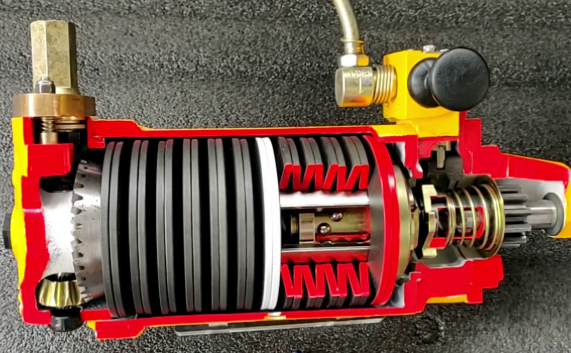
The mechanical spring starter is the product of decades of engineering refinement applied to one of industry’s most fundamental challenges: starting powerful diesel and gas engines with absolute reliability. By combining high-grade spring materials with precision-machined mechanical components, modern designs achieve starting performance that rivals or exceeds electrical alternatives in demanding applications.
The Science of Mechanical Energy Storage
Understanding why mechanical spring starters perform so reliably requires appreciating the physics of elastic energy storage. When a spring is compressed or wound, the atoms within the spring material are displaced from their equilibrium positions. The electromagnetic forces between atoms resist this displacement, storing energy that is returned when the spring is released.
The energy stored in a spring is governed by Hooke’s Law: E = ½kx², where k is the spring constant and x is the displacement. This means that doubling the compression quadruples the stored energy—a relationship that allows engineers to design springs with precisely calibrated energy storage for specific starting applications.
Material Science Behind High-Performance Springs
Alloy Steel Selection
The spring material is the foundation of everything. High-quality mechanical spring starters use alloy steels specifically developed for spring applications—typically chrome-silicon or chrome-vanadium alloys that combine high yield strength with excellent fatigue resistance. The yield strength determines how much energy can be stored; the fatigue resistance determines how many cycles the spring can survive.
Heat Treatment Processes
Raw spring steel achieves its performance characteristics through precise heat treatment. Quenching and tempering processes create the hardness and toughness profile needed for spring applications. Shot peening the spring surface after heat treatment introduces compressive residual stresses that further improve fatigue life by inhibiting surface crack initiation.
Mechanical Drive System Design
The drive system that transfers spring energy to the engine flywheel is equally important as the spring itself. Key design elements include:
- Gear ratio optimization: balances speed multiplication against torque output
- Pinion gear hardness: must withstand repeated high-impact engagement with ring gear
- Overrunning clutch: prevents engine from backdiving into starter after ignition
- Engagement timing: ensures complete mesh before energy release begins
- Release latch: must hold full spring tension until intentionally triggered
Manufacturing Quality Standards
The reliability of a mechanical spring starter depends heavily on manufacturing precision. Critical dimensions—gear tooth profiles, bearing bores, shaft diameters, housing surfaces—must be held to tight tolerances to ensure proper function across the device’s operational life. The best manufacturers use CNC machining, coordinate measuring machines, and comprehensive testing protocols to verify dimensional conformance.
Material traceability is another mark of quality manufacturing. Being able to verify the alloy composition and heat treatment history of every spring ensures that no substandard material enters the production process.
See also: Compare and Book Affordable Flights to India from USA Easily
Field Performance Data
Field performance data from industrial installations tells the real story of mechanical spring starter reliability. Installations in Arctic oil fields consistently report trouble-free starting performance through winters where temperatures routinely fall below -40°C. Marine operators report multi-decade service lives with only routine maintenance. Emergency generator applications document zero starting failures over observation periods spanning several years.
Comparing Mechanical Quality Levels
The industrial spring starter market includes products at very different quality levels. Evaluating quality requires looking beyond price to consider material specifications, manufacturing processes, testing protocols, and the manufacturer’s track record in demanding applications. Cutting corners on any of these factors compromises the reliability that makes spring starting technology valuable in the first place.
Frequently Asked Questions
How can I verify a spring starter’s quality before purchase?
Request material certifications, manufacturing quality certifications, and test records. Ask for references from similar applications. Examine the product’s physical quality—the fit and finish of machined components is a reliable indicator of overall manufacturing standards.
What is the maximum number of cycles a high-quality spring can achieve?
Premium spring materials and manufacturing processes can achieve spring life of 50,000 cycles or more in spring starter applications. Regular inspection allows fatigue to be identified before failure occurs.
Does the operating temperature affect spring performance?
At extreme temperatures, the spring constant does change slightly—springs become marginally stiffer in cold conditions and slightly more compliant in heat. Quality manufacturers account for this in their design calculations to ensure reliable performance across the full rated temperature range.
Conclusion
The mechanical spring starter is a precision engineering achievement that delivers industrial-grade reliability through the elegant application of material science and mechanical design. Understanding the engineering behind these devices helps operators appreciate why quality matters and make purchasing decisions that deliver long-term value. For applications where starting reliability is non-negotiable, the investment in premium mechanical spring starting technology is an investment in operational excellence.